> ## Documentation Index
> Fetch the complete documentation index at: https://docs.pushcash.com/llms.txt
> Use this file to discover all available pages before exploring further.
# Enable webhook notifications
## Goal
Receive asynchronous updates for payment authorizations so your internal transaction state remains accurate and reliable.
## Steps
***
## Step 1: Configure webhook delivery on authorization requests
What you need to do
Include webhook configuration when submitting authorization requests so Push can notify your system of final payment results.
#### How to do it
When calling [authorize-payment](./apireference/authorization/authorize-payment), provide:
* A `webhook_url` where Push will deliver webhook events
* A `webhook_secret` used to verify webhook authenticity
* A `tag` that maps webhook events back to your internal transaction record
This ensures your system can recover final payment outcomes even if the authorization request times out or returns an
ambiguous response.
## Step 2: Receive and process webhook events
What you need to do
Expose an HTTPS endpoint that can receive webhook events from Push, verify their authenticity, and update your internal
transaction state.
#### How to do it
1. Create a HTTP endpoint at the configured `webhook_url` capable of receiving POST requests.
2. Verify the webhook signature and timestamp for each request (see [security](#security)).
3. Parse the webhook payload and update the transaction record in your database accordingly. Please refer to the [reference guide](./webhook-types) for the structure of the webhook payload.
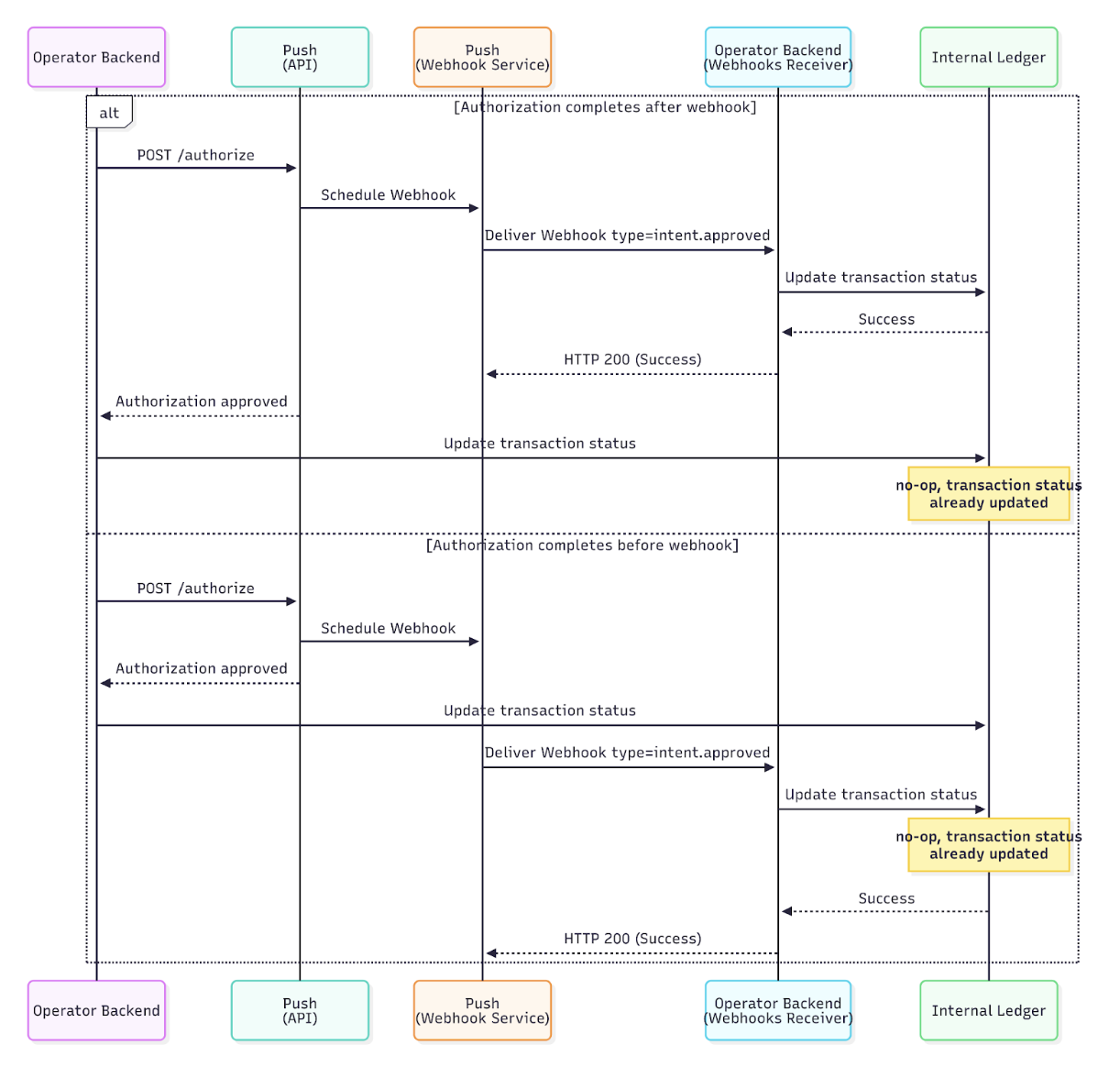
Due to the asynchronous nature of webhook delivery, your integration must support out-of-order delivery and handle duplicate events idempotently. See [Independent Ordering](#independent-ordering) and [Idempotency](#idempotency) for more information.
## Security
Webhooks deliver data directly to an endpoint you control over the public internet. Because they are invoked automatically
by Push, webhook endpoints **must be explicitly secured** to prevent unauthorized requests, data tampering, and replay attacks.
Without proper verification, a malicious actor could spoof webhook requests and falsely mark payments as approved or declined in your system.
If your cloud data environment restricts network access from external IPs via a firewall, you may need to allow inbound
traffic from Push IP addresses in order to receive webhook requests.
**Production** `44.238.180.175`
**Sandbox** `34.209.246.44`
### Signature verification
When a `webhook_secret` is provided, Push signs each webhook request using an HMAC-SHA256 signature derived from the raw
request payload. This allows your application to verify that:
* The request was sent by Push
* The payload has not been modified in transit
Every webhook request must be verified before it is processed.
**Signature format**
```
X-Webhook-Signature: sha256=
```
**Verification steps**
1. Extract the signature from the `X-Webhook-Signature` header
2. Read the raw request body as bytes (before parsing JSON)
3. Compute an HMAC-SHA256 signature using your `webhook_secret` and the raw body
4. Compare the computed signature to the received signature using constant-time comparison
5. Reject requests with invalid signatures (`401 Unauthorized`)
```javascript JavaScript (Node.js) theme={null}
const crypto = require('crypto');
function verifyWebhookSignature(secret, rawBody, signatureHeader) {
// Parse signature from header
if (!signatureHeader || !signatureHeader.startsWith('sha256=')) {
return false;
}
const receivedSignature = signatureHeader.substring(7); // Remove 'sha256=' prefix
// Compute expected signature
const hmac = crypto.createHmac('sha256', secret);
hmac.update(rawBody); // rawBody must be Buffer or string
const expectedSignature = hmac.digest('hex');
// Constant-time comparison to prevent timing attacks
return crypto.timingSafeEqual(
Buffer.from(receivedSignature, 'hex'),
Buffer.from(expectedSignature, 'hex')
);
}
// Express.js example
app.post('/webhooks/push', express.raw({ type: 'application/json' }), (req, res) => {
const signature = req.headers['x-webhook-signature'];
const rawBody = req.body; // Raw buffer from express.raw()
if (!verifyWebhookSignature(WEBHOOK_SECRET, rawBody, signature)) {
return res.status(401).send('Invalid signature');
}
// Parse JSON after verification
const payload = JSON.parse(rawBody.toString());
// Verify timestamp (see below)
// Process webhook...
res.status(200).send('OK');
});
```
```python Python theme={null}
import hmac
import hashlib
import time
from datetime import datetime, timezone
def verify_webhook_signature(secret: str, raw_body: bytes, signature_header: str) -> bool:
"""Verify webhook signature using constant-time comparison."""
if not signature_header or not signature_header.startswith('sha256='):
return False
received_signature = signature_header[7:] # Remove 'sha256=' prefix
# Compute expected signature
expected_signature = hmac.new(
secret.encode('utf-8'),
raw_body,
hashlib.sha256
).hexdigest()
# Constant-time comparison
return hmac.compare_digest(received_signature, expected_signature)
# Flask example
@app.route('/webhooks/push', methods=['POST'])
def handle_webhook():
signature = request.headers.get('X-Webhook-Signature')
raw_body = request.get_data()
if not verify_webhook_signature(WEBHOOK_SECRET, raw_body, signature):
return 'Invalid signature', 401
payload = request.get_json()
# Verify timestamp (see below)
# Process webhook...
return 'OK', 200
```
```go Go theme={null}
package main
import (
"crypto/hmac"
"crypto/sha256"
"encoding/hex"
"io"
"net/http"
"strings"
)
func verifyWebhookSignature(secret string, rawBody []byte, signatureHeader string) bool {
if !strings.HasPrefix(signatureHeader, "sha256=") {
return false
}
receivedSignature := signatureHeader[7:] // Remove 'sha256=' prefix
// Compute expected signature
mac := hmac.New(sha256.New, []byte(secret))
mac.Write(rawBody)
expectedSignature := hex.EncodeToString(mac.Sum(nil))
// Constant-time comparison
return hmac.Equal([]byte(receivedSignature), []byte(expectedSignature))
}
func handleWebhook(w http.ResponseWriter, r *http.Request) {
signature := r.Header.Get("X-Webhook-Signature")
rawBody, _ := io.ReadAll(r.Body)
if !verifyWebhookSignature(webhookSecret, rawBody, signature) {
http.Error(w, "Invalid signature", http.StatusUnauthorized)
return
}
// Parse JSON after verification
var payload WebhookPayload
json.Unmarshal(rawBody, &payload)
// Verify timestamp (see below)
// Process webhook...
w.WriteHeader(http.StatusOK)
}
```
```csharp C# (.NET) theme={null}
using System;
using System.Security.Cryptography;
using System.Text;
using Microsoft.AspNetCore.Mvc;
public class WebhookSignatureVerifier
{
public static bool VerifyWebhookSignature(string secret, byte[] rawBody, string signatureHeader)
{
// Parse signature from header
if (string.IsNullOrEmpty(signatureHeader) || !signatureHeader.StartsWith("sha256="))
{
return false;
}
string receivedSignature = signatureHeader.Substring(7); // Remove 'sha256=' prefix
// Compute expected signature
using (var hmac = new HMACSHA256(Encoding.UTF8.GetBytes(secret)))
{
byte[] hashBytes = hmac.ComputeHash(rawBody);
string expectedSignature = BitConverter.ToString(hashBytes)
.Replace("-", "")
.ToLower();
// Constant-time comparison to prevent timing attacks
return CryptographicOperations.FixedTimeEquals(
Encoding.UTF8.GetBytes(receivedSignature),
Encoding.UTF8.GetBytes(expectedSignature)
);
}
}
}
// ASP.NET Core Controller Example
[ApiController]
[Route("webhooks")]
public class WebhooksController : ControllerBase
{
private readonly string _webhookSecret;
public WebhooksController(IConfiguration configuration)
{
_webhookSecret = configuration["WebhookSecret"];
}
[HttpPost("push")]
public async Task HandleWebhook()
{
string signature = Request.Headers["X-Webhook-Signature"];
// Read raw body as bytes
using (var reader = new StreamReader(Request.Body, Encoding.UTF8, leaveOpen: true))
{
Request.Body.Position = 0;
byte[] rawBody = await new StreamReader(Request.Body).BaseStream.ReadAllBytesAsync();
if (!WebhookSignatureVerifier.VerifyWebhookSignature(_webhookSecret, rawBody, signature))
{
return Unauthorized(new { error = "Invalid signature" });
}
// Parse JSON after verification
string bodyString = Encoding.UTF8.GetString(rawBody);
var payload = JsonSerializer.Deserialize(bodyString);
// Verify timestamp (see below)
// Process webhook...
return Ok();
}
}
}
```
```php PHP theme={null}
'Invalid signature']);
exit;
}
// Parse JSON after verification
$payload = json_decode($rawBody, true);
// Verify timestamp (see below)
// Process webhook...
http_response_code(200);
echo json_encode(['status' => 'OK']);
?>
// Laravel Example
Route::post('/webhooks/push', function (Request $request) {
$signature = $request->header('X-Webhook-Signature');
$rawBody = $request->getContent(); // Get raw request body
if (!verifyWebhookSignature(env('WEBHOOK_SECRET'), $rawBody, $signature)) {
return response()->json(['error' => 'Invalid signature'], 401);
}
$payload = json_decode($rawBody, true);
// Verify timestamp (see below)
// Process webhook...
return response()->json(['status' => 'OK'], 200);
});
// Symfony Example
use Symfony\Component\HttpFoundation\Request;
use Symfony\Component\HttpFoundation\Response;
class WebhookController extends AbstractController
{
#[Route('/webhooks/push', methods: ['POST'])]
public function handleWebhook(Request $request): Response
{
$signature = $request->headers->get('X-Webhook-Signature');
$rawBody = $request->getContent();
if (!$this->verifyWebhookSignature($_ENV['WEBHOOK_SECRET'], $rawBody, $signature)) {
return new Response(
json_encode(['error' => 'Invalid signature']),
Response::HTTP_UNAUTHORIZED,
['Content-Type' => 'application/json']
);
}
$payload = json_decode($rawBody, true);
// Verify timestamp (see below)
// Process webhook...
return new Response(
json_encode(['status' => 'OK']),
Response::HTTP_OK,
['Content-Type' => 'application/json']
);
}
}
```
```ruby Ruby on Rails theme={null}
require 'openssl'
def verify_webhook_signature(secret, raw_body, signature_header)
# Parse signature from header
return false if signature_header.nil? || !signature_header.start_with?('sha256=')
received_signature = signature_header[7..-1] # Remove 'sha256=' prefix
# Compute expected signature
expected_signature = OpenSSL::HMAC.hexdigest('SHA256', secret, raw_body)
# Constant-time comparison to prevent timing attacks
ActiveSupport::SecurityUtils.secure_compare(received_signature, expected_signature)
end
# Rails Controller Example
class WebhooksController < ApplicationController
# Disable CSRF protection for webhook endpoint
skip_before_action :verify_authenticity_token
def push
signature = request.headers['X-Webhook-Signature']
raw_body = request.raw_post # Get raw request body
unless verify_webhook_signature(WEBHOOK_SECRET, raw_body, signature)
render json: { error: 'Invalid signature' }, status: :unauthorized
return
end
payload = JSON.parse(raw_body)
# Verify timestamp (see below)
# Process webhook...
head :ok
end
end
```
### Timestamp Verification
The `timestamp` field in the webhook payload indicates when the webhook was created. To prevent replay attacks, verify that the timestamp is recent (within 10 minutes).
**Verification Steps**
1. Parse the `timestamp` field from the payload (`ISO 8601`format)
2. Compare with current time
3. Reject requests older than 10 minutes (return`401 Unauthorized`)
```javascript JavaScript (Node.js) theme={null}
function verifyWebhookTimestamp(timestamp, maxAgeMinutes = 10) {
const webhookTime = new Date(timestamp);
const now = new Date();
const ageMinutes = (now - webhookTime) / 1000 / 60;
return ageMinutes <= maxAgeMinutes;
}
// In your webhook handler
if (!verifyWebhookTimestamp(payload.timestamp)) {
return res.status(401).send('Webhook timestamp too old');
}
```
```python Python theme={null}
from datetime import datetime, timezone, timedelta
def verify_webhook_timestamp(timestamp_str: str, max_age_minutes: int = 10) -> bool:
"""Verify webhook timestamp is within acceptable age."""
webhook_time = datetime.fromisoformat(timestamp_str.replace('Z', '+00:00'))
now = datetime.now(timezone.utc)
age = now - webhook_time
return age <= timedelta(minutes=max_age_minutes)
# In your webhook handler
if not verify_webhook_timestamp(payload['timestamp']):
return 'Webhook timestamp too old', 401
```
```go Go theme={null}
import "time"
func verifyWebhookTimestamp(timestamp string, maxAgeMinutes int) bool {
webhookTime, err := time.Parse(time.RFC3339, timestamp)
if err != nil {
return false
}
age := time.Since(webhookTime)
return age <= time.Duration(maxAgeMinutes) * time.Minute
}
// In your webhook handler
if !verifyWebhookTimestamp(payload.Timestamp, 10) {
http.Error(w, "Webhook timestamp too old", http.StatusUnauthorized)
return
}
```
```csharp C# (.NET) theme={null}
using System;
public class WebhookTimestampVerifier
{
public static bool VerifyWebhookTimestamp(string timestampStr, int maxAgeMinutes = 10)
{
try
{
// Parse ISO 8601 timestamp
DateTime webhookTime = DateTime.Parse(timestampStr, null,
System.Globalization.DateTimeStyles.RoundtripKind);
// Ensure UTC
if (webhookTime.Kind != DateTimeKind.Utc)
{
webhookTime = webhookTime.ToUniversalTime();
}
DateTime now = DateTime.UtcNow;
TimeSpan age = now - webhookTime;
// Check if timestamp is in the future (clock skew protection)
if (age.TotalMinutes < 0)
{
return false;
}
return age.TotalMinutes <= maxAgeMinutes;
}
catch (FormatException)
{
// Invalid timestamp format
return false;
}
}
}
// In your webhook handler
if (!WebhookTimestampVerifier.VerifyWebhookTimestamp(payload.Timestamp))
{
return Unauthorized(new { error = "Webhook timestamp too old" });
}
```
```php PHP theme={null}
diff($webhookTime);
$ageMinutes = ($interval->days * 24 * 60) +
($interval->h * 60) +
$interval->i +
($interval->s / 60);
// Check if webhook is from the future (clock skew protection)
if ($interval->invert === 0) {
return false;
}
return $ageMinutes <= $maxAgeMinutes;
} catch (Exception $e) {
// Invalid timestamp format
return false;
}
}
// In your webhook handler
if (!verifyWebhookTimestamp($payload['timestamp'])) {
http_response_code(401);
echo json_encode(['error' => 'Webhook timestamp too old']);
exit;
}
// In your webhook handler (Laravel)
if (!verifyWebhookTimestamp($payload['timestamp'])) {
return response()->json(['error' => 'Webhook timestamp too old'], 401);
}
// In your webhook handler (Symfony)
if (!$this->verifyWebhookTimestamp($payload['timestamp'])) {
return new JsonResponse(
['error' => 'Webhook timestamp too old'],
Response::HTTP_UNAUTHORIZED
);
}
```
```ruby Ruby on Rails theme={null}
require 'time'
def verify_webhook_timestamp(timestamp_str, max_age_minutes = 10)
# Parse ISO 8601 timestamp
webhook_time = Time.parse(timestamp_str).utc
now = Time.now.utc
age_minutes = (now - webhook_time) / 60.0
age_minutes <= max_age_minutes
rescue ArgumentError
# Invalid timestamp format
false
end
# In your webhook handler
unless verify_webhook_timestamp(payload['timestamp'])
render json: { error: 'Webhook timestamp too old' }, status: :unauthorized
return
end
```
```bash Authorize Payment with Webhook Configuration theme={null}
curl --request POST \
--url https://sandbox.pushcash.com/authorize \
--header 'Authorization: Bearer ' \
--header 'Content-Type: application/json' \
--data '
{
"user_id": "user_lVpbPL0K1XIiHx0DxipRbD",
"amount": 2500,
"currency": "USD",
"direction": "cash_in",
"token": "token_mbDRHFi3dxIZEtykHsgUGC",
"webhook_url": "https://yourapp.com/webhooks/push",
"webhook_secret": "whsec_32_characters_minimum",
"tag": "txn_12345"
}
'
```
## Independent Ordering
Webhook delivery and authorization responses are independent and may arrive in any order. Your system must handle both scenarios by ensuring that the internal transaction record is committed to the database *before* the call to the authorization endpoint:
1. Webhook arrives first (before authorization response)
2. Authorization response arrives first (before webhook)
*Sequence diagram illustrates the two possible scenarios of ordering between webhook delivery and authorization results.*
 ## Idempotency
Push provides at-least-once delivery for webhooks. Your application must handle duplicate webhook deliveries gracefully using database transactions to ensure idempotency. In the case of a duplicated webhook delivery from Push either due to an error or timeout from your callback handler, you should discard the request and return a`200 OK`.
If Push does not receive a`200 OK`response from your webhook endpoint, delivery will be retried with exponential backoff.
| Environment | Retry Behavior |
| :------------- | :---------------------------------------------------- |
| **Sandbox** | Up to 3 attempts |
| **Production** | Up to 40 attempts over 3 days, then marked as expired |
## Integration checklist
* Payment requests include the `webhook_url`, `webhook_secret`, and `tag` parameters
* Webhook endpoint is reachable over HTTPS from the Push IP addresses
* Webhook signatures and timestamps are verified before processing
* Duplicate webhook deliveries are handled idempotently
## Idempotency
Push provides at-least-once delivery for webhooks. Your application must handle duplicate webhook deliveries gracefully using database transactions to ensure idempotency. In the case of a duplicated webhook delivery from Push either due to an error or timeout from your callback handler, you should discard the request and return a`200 OK`.
If Push does not receive a`200 OK`response from your webhook endpoint, delivery will be retried with exponential backoff.
| Environment | Retry Behavior |
| :------------- | :---------------------------------------------------- |
| **Sandbox** | Up to 3 attempts |
| **Production** | Up to 40 attempts over 3 days, then marked as expired |
## Integration checklist
* Payment requests include the `webhook_url`, `webhook_secret`, and `tag` parameters
* Webhook endpoint is reachable over HTTPS from the Push IP addresses
* Webhook signatures and timestamps are verified before processing
* Duplicate webhook deliveries are handled idempotently